


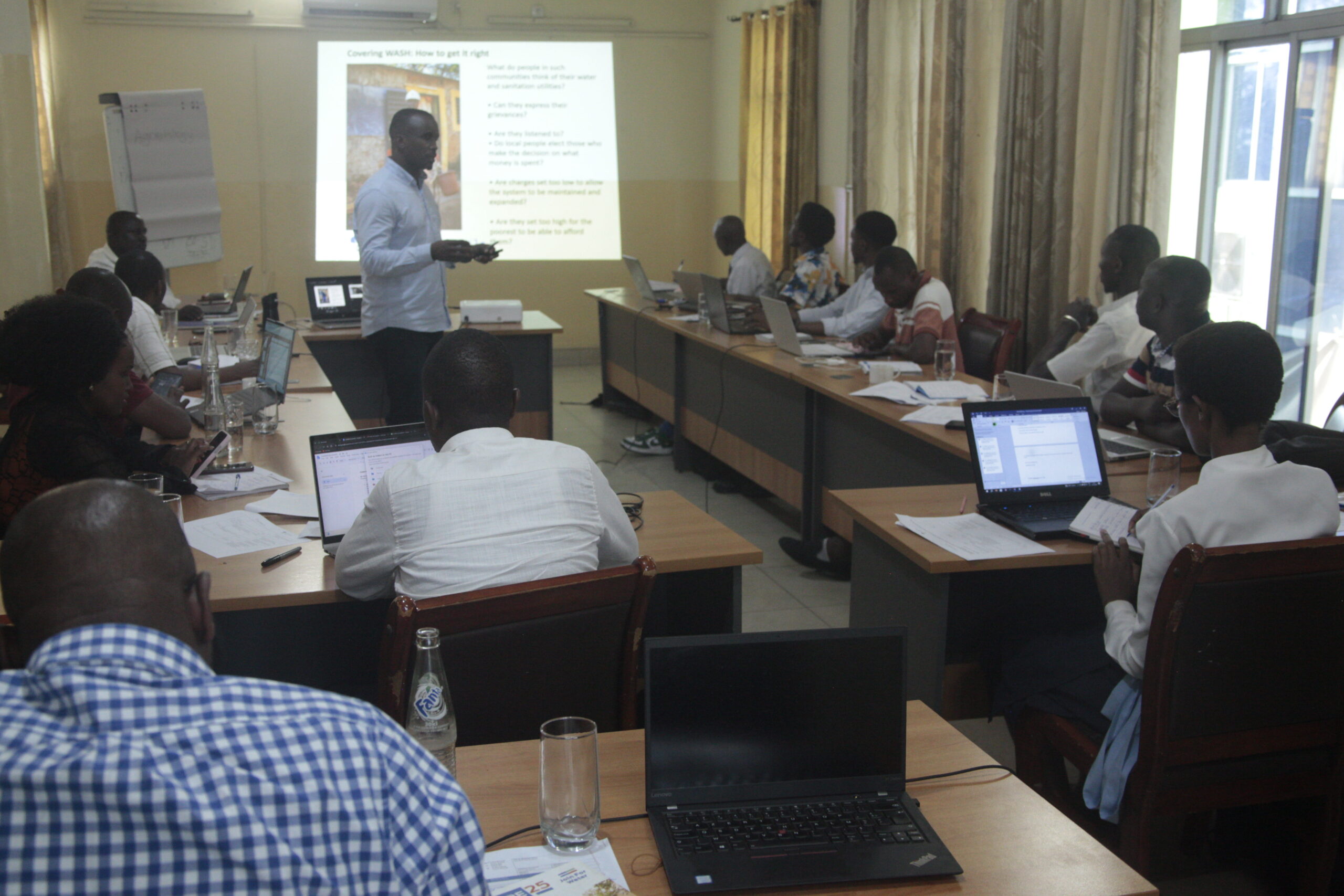
BUJUMBURA. Journalists in Burundi have been urged to shift away from traditional crisis reporting and focus on human-centered, collaborative storytelling to effectively cover the country’s growing climate threats.
The call was made during a two-day media training workshop hosted by the non-governmental organisation Join For Water Burundi and the environmental journalism network InfoNile at the Hôtel Le Chandelier in Bujumbura, Burundi.
Speaking during the workshop, Fredrick Mugira, an Atlantic Fellow at the London School of Economics and founder of Water Journalists Africa, and cofounder of InfoNile, urged reporters to rethink their approach to environmental and science reporting. He challenged journalists to hold public authorities accountable on basic service provision and policy implementation, asking whether publicly supplied water is safe to drink and whether governments have clear, budgeted timetables to bring clean water and sanitation to every citizen rather than relying on isolated pilot projects.
Mugira highlighted the systemic barriers that prevent environmental issues from reaching the front pages, noting that science stories are often sidelined as complex, boring, or commercially unviable. He argued that a persistent gap in technical skills, combined with a lack of managerial support for journalists venturing into field investigations, has allowed critical crises to go under-reported across the region.
To overcome these hurdles, Mugira called for a shift toward collaborative multimedia journalism that connects reporters directly with scientific researchers and affected communities. He emphasized the importance of translating dense scientific findings into accessible language, using tools such as drone imagery, satellite mapping, and data visualization to make complex stories engaging without losing rigor.
To close the loop between newsrooms and the public, he advocated for « returning stories to the source » through community screenings and local exhibitions. According to Mugira, giving voice to marginalized populations and creating spaces for local dialogue not only builds trust between reporters and their audiences but also drives concrete action by local governments to address climate and sanitation challenges.
Drawing on the concept of agnotology—the study of how ignorance is deliberately cultivated or manipulated—Mugira warned journalists to remain vigilant against actors who deliberately spread misinformation or sow doubt about environmental issues to exploit society.
« The future of environmental journalism lies in collaboration, not in the race for the scoop, » Mugira said. He encouraged the reporters to look beyond reporting on immediate disasters and begin documenting indigenous climate solutions.
Data and Visual storytelling
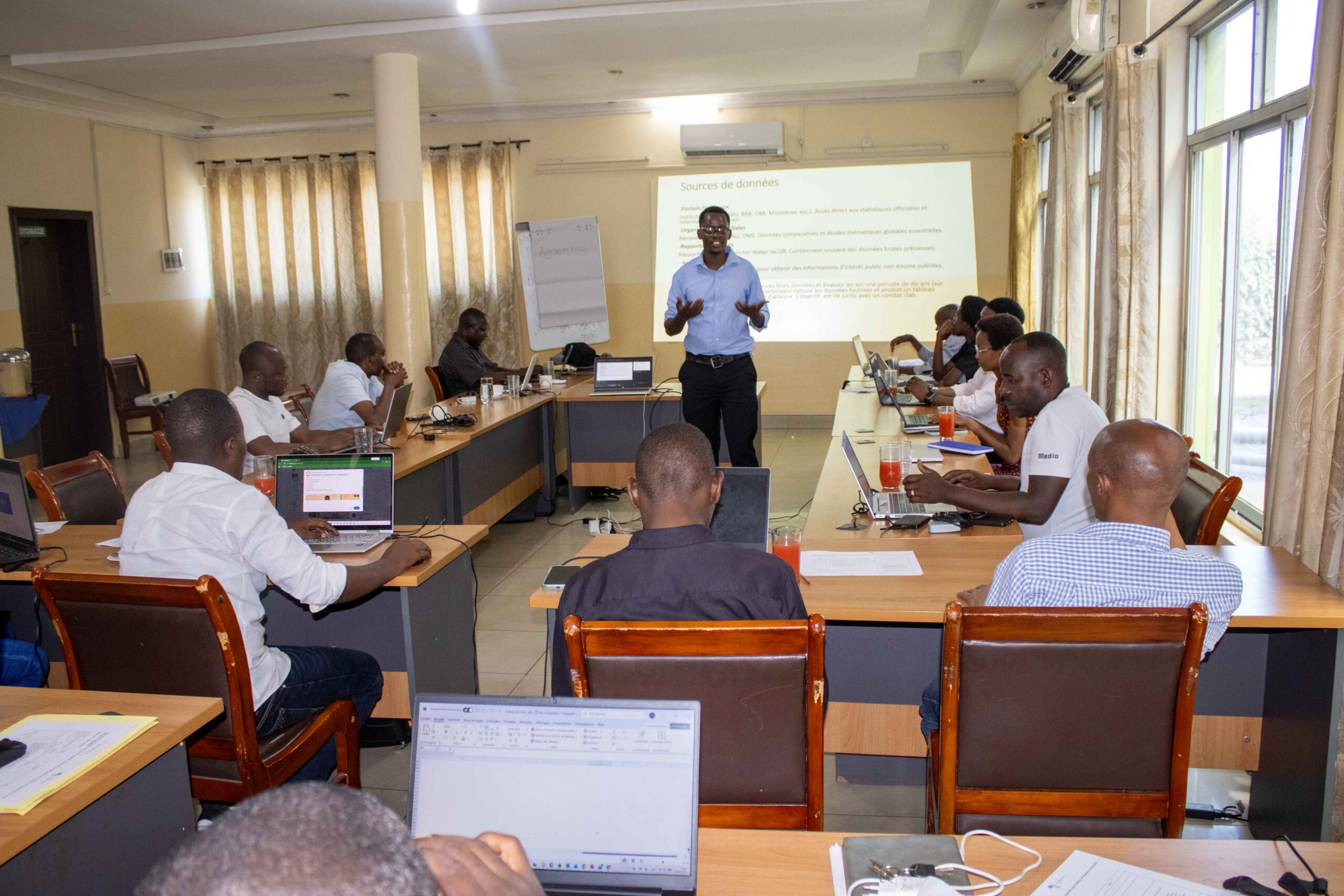
During the training sessions, Arthur Bizimana, the Burundi coordinator for InfoNile and founder of the news site Ibihe, noted that data must be treated as a fundamental « fourth source » of news, taking its place alongside direct observation, official documents, and interviews.
He argued that integrating statistics into investigative reporting gives journalists mathematical precision and scientific rigor, thereby turning subjective claims into verifiable facts.
« Data converts vague assertions into measurable proof, » Bizimana told participants. He pointed out that cross-referencing datasets allows reporters to uncover hidden trends such as corruption in public procurement while maintaining complete neutrality.
While taking the journalists through the processes of cleaning, analysing, and visualising data, Bizimana cautioned that raw figures must be thoroughly vetted for gaps, age, and methodological flaws before they can be used.
Using tools such as Google Sheets alongside graphics platforms like Datawrapper and Flourish, he showed how complex spreadsheets can be turned into clear maps and charts.
« The credibility of journalism relies on rigorous documentation of the journey from raw data to published results, » Bizimana said. He warned the reporters against dramatising or over-interpreting their findings.
On the subject of documentary photojournalism, Bizimana outlined a three-stage approach that begins well before heading into the field.
He urged journalists to form clear narrative hypotheses, test them with local residents, and vary their camera angles, combining wide landscape shots, medium action shots, and close-up emotional portraits, to capture genuine moments rather than staged poses.
He, however, cautioned that effective photojournalism relies on editorial restraint rather than the quantity of images taken.
« Fifteen exceptional photos carry far more weight than an inconsistent series of 500, » Bizimana said, adding that field assignments are only complete once images are accurately captioned, answering the basic questions of who, what, where, when, and why.
Participants said they had found the training valuable.
Sonia Kamikazi, a journalist with Radio Bonesha FM, said the skills learned would help her day-to-day reporting on environmental issues, and pledged to produce more such coverage.
Eraste Manishaka, a journalist and director of Radio Isoko, said the workshop had shown him the importance of covering water and climate issues.
« We have realised the importance of our role, learned how to cover these kinds of topics, and we are eager to get to work, » he said.
His colleague at Radio Isoko, Henriette Kagwiza, said data journalism was new to her. « I’m going to use it to produce well-researched and credible reporting, » she said.
Investigating Resistance to Sustainable Farming
The workshop forms part of a wider partnership between InfoNile and Join For Water Burundi aimed at strengthening environmental coverage across the region.
Evariste Ntakirutimana, country coordinator for Join For Water Burundi, urged journalists to investigate why some communities remain reluctant to adopt long-term sustainable practices, such as contour farming, which is encouraged by the government.
« Farmers adopt these sustainable farming practices for the duration of the project, only to abandon them as soon as it comes to an end, » Ntakirutimana said. « We want to understand why. This is where your role is needed, » he stressed.